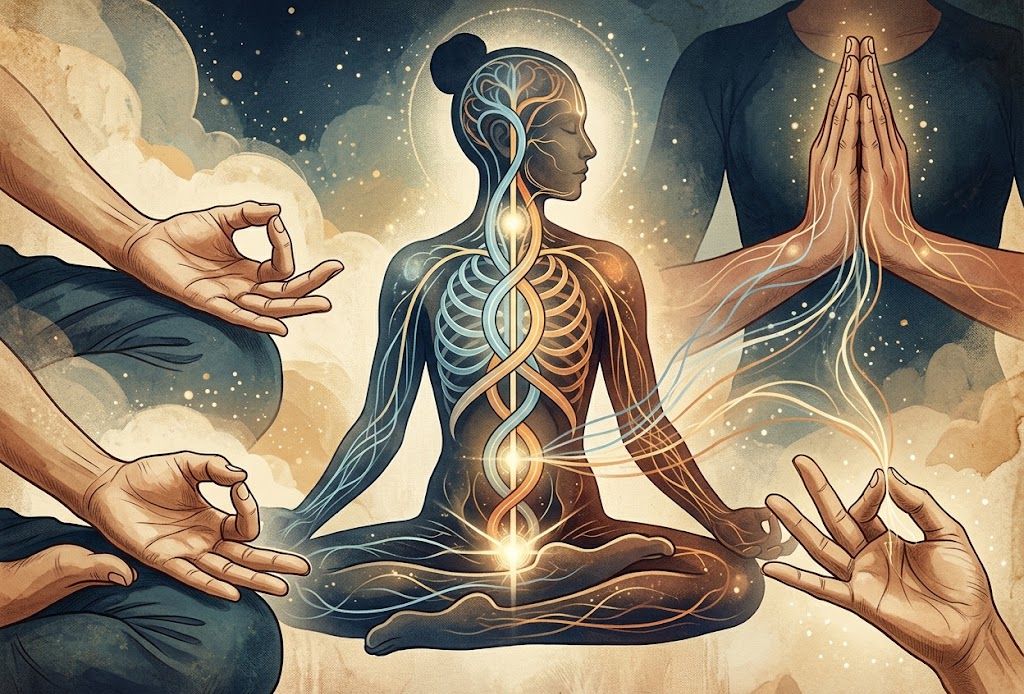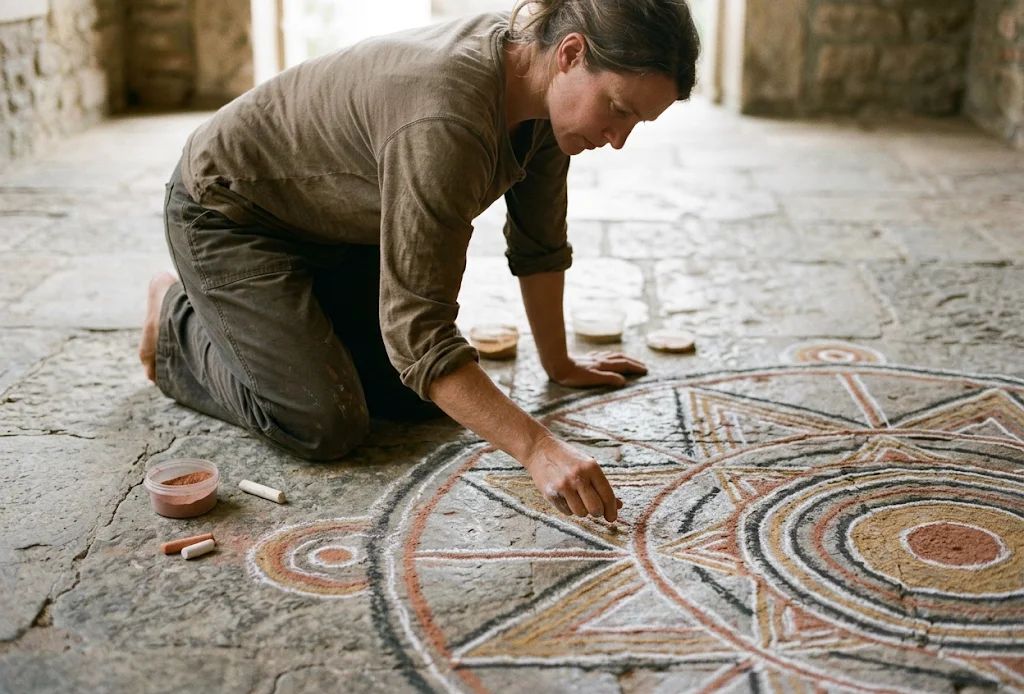
Tantra brings together spiritual traditions from India, both Hindu and Buddhist, which developed paths of transformation and realization through a particular conception of the body, consciousness, and reality. Its teachings are expressed in texts, rituals, and practices that integrate breathing, sound, visualization, meditation, and the worship of deities.
Many tantric traditions consider that reality itself, with its different dimensions, can be part of the spiritual path. The body, energy, mind, and senses are not necessarily obstacles to be abandoned, but aspects of existence that can be incorporated into practice.
Tantra does not constitute a single school or a uniform doctrine. Its different currents, both Hindu and Buddhist, developed their own methods and conceptions, although they share a search for spiritual transformation in which knowledge, practice, and experience occupy a central place.
The word tantra literally means loom or weave. It derives from the root tan, which expresses extending, expanding, and weaving. In the oldest texts, such as the Rigveda, the word appears linked to the loom; over time, it acquired meanings related to the development of a teaching, a framework, or a system, and came to designate a class of texts and practices. Its exact meaning depends on the context and the tradition that uses it.
Tantric traditions developed from the middle of the first millennium of the common era. They emerged in different currents of Hinduism and Buddhism, especially within Shaivism, Shaktism, and Mahayana Buddhism, and also extended to Vaishnavism. The texts that describe them are known as tantras, agamas, or samhitas. Many of the earliest preserved tantric texts date from between the 5th and 10th centuries, although the traditions themselves consider their teachings to have a revealed and timeless origin.
There are Shaiva, Shakta, Vaishnava, and Buddhist currents. Shaiva tantra is centered on Shiva, while Shakta tantra is oriented toward the goddess and Shakti as divine power. Among its traditions are Kaula and Kashmir Shaivism. In Buddhism, Vajrayana, developed especially in the Tibetan tradition, is also known as Mantrayana, the vehicle of mantra. Each current developed its own texts, practices, and forms of transmission.
Tantric practices are part of a spiritual discipline called sadhana. In many traditions, this practice begins with initiation (diksha), through which the teacher transmits a teaching and authorizes the disciple to participate in certain practices. Sadhana can combine different means: mantra, the sound that is repeated with attention; mudra, a gesture of the body or hands; yantra and mandala, diagrams that are contemplated to sustain attention; visualization and meditation (dhyana); puja, ritual worship with offerings and prayers directed to a deity; and various purification practices.
In many tantric traditions, the body occupies a central place in practice. From this arise concepts such as the nadis or channels, the chakras or centers, and kundalini, which form part of different conceptions of the subtle body. Chakra systems appear in Hindu and Buddhist tantric texts, and vary in number, location, and meaning. Hatha yoga later incorporated part of that vocabulary and developed its own ways of working with the body, breathing, and energy, including mudras and bandhas.
Many Shaiva and Shakta currents understand reality through the relationship between Shiva and Shakti. Shiva represents consciousness and Shakti the power of manifestation. Both are described as inseparable and, in some traditions, as two aspects of the same reality. This conception runs through their texts, rituals, and practices, and offers a way of understanding the relationship between consciousness and that which manifests.
To understand tantra is to approach a set of traditions in which transformation is carried out through experience. Its different currents developed their own ways of integrating the body, consciousness, and reality into practice. Through their teachings and disciplines, tantric currents propose a path of spiritual realization that finds in existence itself a ground for knowledge and transformation.