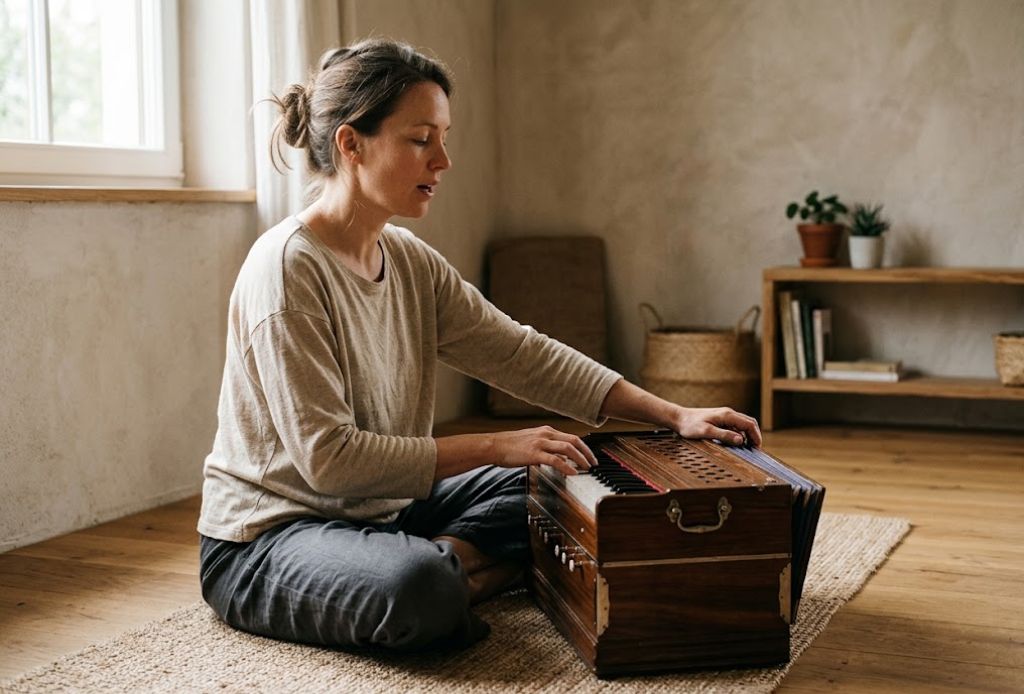
A mantra is a sound, a syllable or a phrase that is repeated with attention. It appears in many yoga traditions and also outside of them, and its function is always similar: to offer the mind a simple, constant object on which to rest. More than a special formula, it is one of the oldest tools for sustaining concentration.
The word mantra is usually explained from two Sanskrit roots. Man refers to thinking or to the mind, and tra to an instrument or means, so the term is understood as "instrument of thought." In the Vedic texts it designates the verses and formulas that were recited during ritual, and from there it came to name any sound used as a support for inner practice.
Patanjali devotes two sutras to this subject. In the first chapter of the Yoga Sutras he presents Om, which he names as pranava, as the sound expression of Ishvara, and then indicates repeating it and reflecting on its meaning: tajjapas tadarthabhavanam. The instruction has two parts that go together, repetition, called japa, and attention to meaning, called bhavana. It is not a matter of pronouncing without more, but of keeping the mind present in what is said.
Japa is the practice of repeating the mantra, and it allows several forms. Tradition distinguishes between repetition aloud, whispered and mental, to which several lineages attribute greater subtlety. It was born in the sphere of Vedic ritual, where formulas were murmured during the ceremony, and over time it became an inner practice with value of its own. It is a journey that goes from the external to the internal, from a ceremonial act to a form of attention.
A mantra works as an object of dharana. As we saw when speaking of Samyama, dharana consists of directing the mind toward a single object and holding it there. The repeated sound fulfills that function well: it is always available, it has a rhythm of its own and it can accompany the breath, so that attention, air and sound advance together. It is a variant of what we described in the article on contemplation within the posture: an object of attention that does not have to be sought outside.
Mantras are grouped into a few families. In the yoga tradition Om is considered the origin of the others, and many mantras carry it at the beginning, such as Om Shanti or Om Namah Shivaya. Others name a deity or a quality, such as Om Mani Padme Hum, from Tibetan Buddhism. In tantra the bija also appear, brief "seed" syllables that are used alone. Other religious traditions have similar forms of repetition, from the Hail Mary to shalom, so that the mantra is a practice that yoga shares with other paths.
In some lineages the teacher gives the mantra, and in others the practitioner chooses it. There are schools that give a personal mantra in an initiation and others that leave it to be chosen according to affinity with a deity or with the sound. In several of them it is recommended to sustain the same mantra for a long time, because the practice settles through repetition and not through constant change.
Kundalini Yoga is one of the schools where the mantra occupies a central place. Spread in the West since the late sixties, it combines kriyas, breathing and meditation with the chanting of mantras, and a class usually begins with the Adi Mantra, Ong Namo Guru Dev Namo. Many of the mantras it uses come from the Sikh tradition: Sat Nam, which is translated as "true name" and is the most used in the school, or Wahe Guru. Historical studies describe this school as a twentieth-century synthesis of yoga techniques and Sikh mantras. It is an example of how the same resource is organized into a method of its own, with its sequence and its vocabulary.
All these forms share the same gesture. Choosing a sound, repeating it with attention and noticing each time the mind leaves and each time it returns. Practiced this way, the mantra is a simple way of working with what we have been describing in this series: the breath, the posture and sustained attention. As in the rest of the practices, the path is refined better with the guidance of someone experienced in the tradition from which that mantra comes.