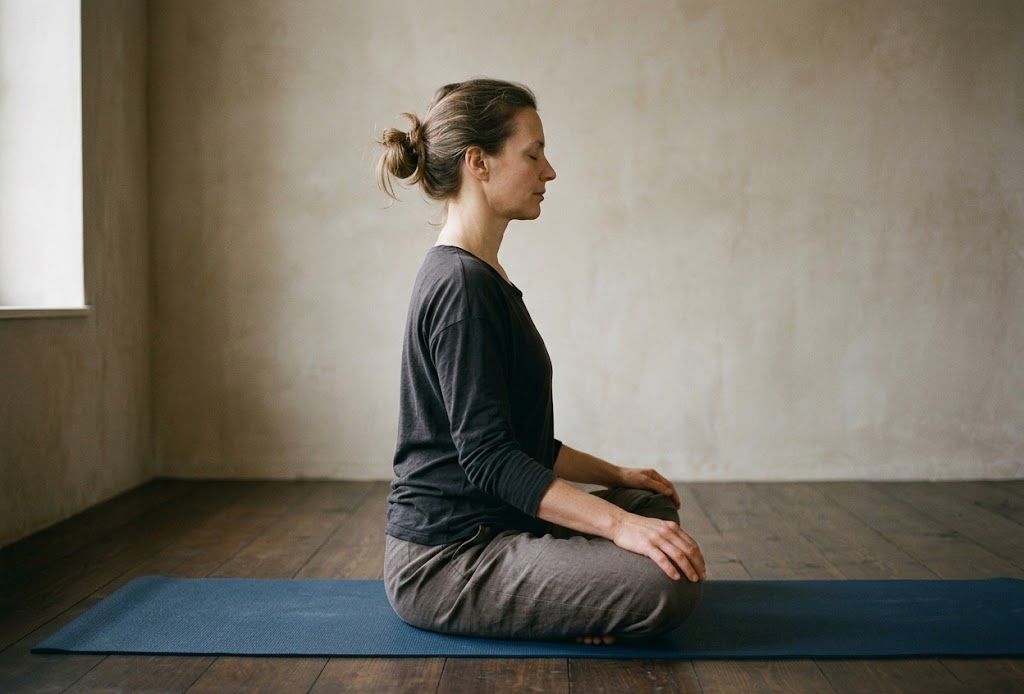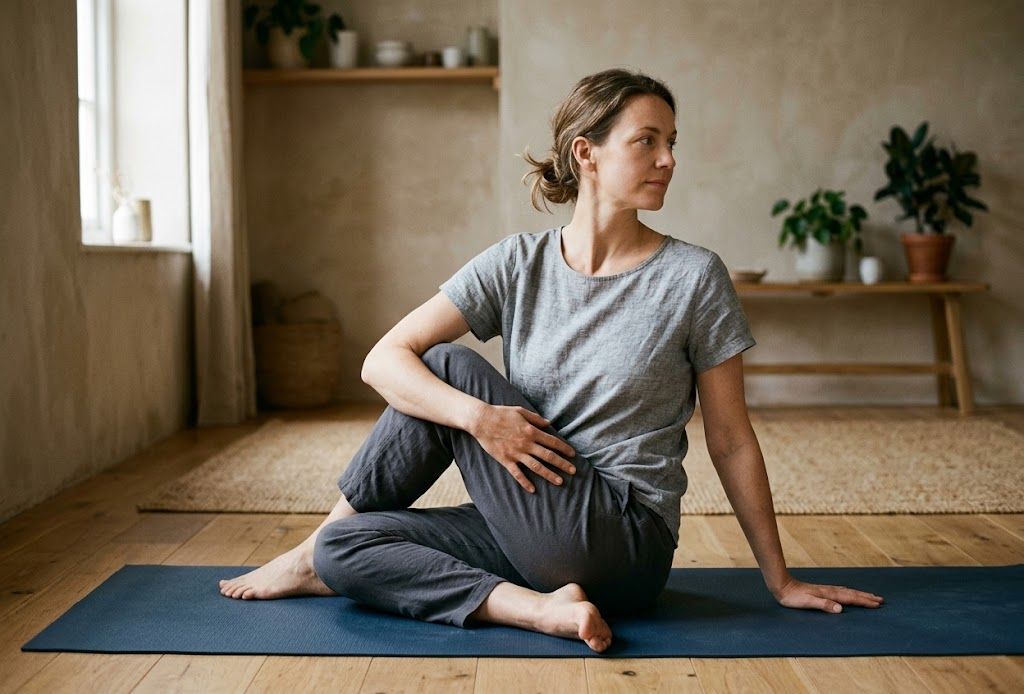
When Patanjali speaks of asana in the Yoga Sutras, he does so in a single line: sthira sukham asanam. The posture is stable and comfortable. He says nothing about form, range, or difficulty. He describes two qualities, and both are internal. That austere definition is the starting point of everything that follows, because it turns the posture into a condition of the mind before a figure of the body.
The two terms need each other. Sthira is firmness, the ability to remain without collapsing. Sukha is spaciousness, the absence of tension that narrows. A stable but uncomfortable posture is rigidity; a comfortable but unstable posture is carelessness. When the two qualities coincide, something appears that was in neither of them separately: a body that no longer demands attention and leaves the mind available.
The Hatha Yoga Pradipika reaches the same conclusion from another side. It presents asana as the first practice because it gives stability, health, and lightness to the body. It is a more practical reading than Patanjali's, but it points in the same direction: the posture is not the end, it is the preparation of an organism that can sustain what comes next, whether pranayama, concentration, or simple stillness.
Patanjali adds an indication that is often overlooked: effort has to be relaxed. He says that the posture is perfected by loosening effort and letting attention be absorbed into something broader than the body itself. It is an almost paradoxical instruction, because it asks you to hold without gripping. And it is what separates a posture maintained by force from a posture inhabited: in the first, the mind is busy enduring; in the second, it remains free.
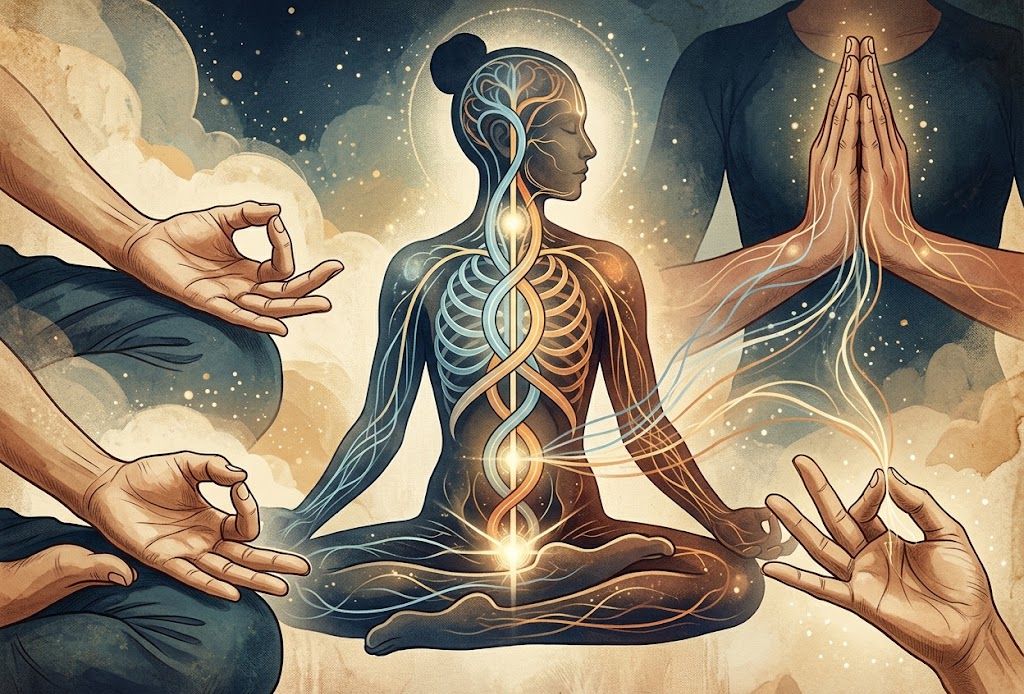
That is where asana becomes the first ground of concentration. In the article on Samyama we saw that dharana is the mind directed toward a single object. Patanjali himself defines it as fixing the mind in one place, and that place can be a region of the body. In a stable and comfortable posture, the breath or a specific area of the body is an object of attention always available: it does not have to be achieved or imagined, it is already present in every moment of the practice.
The breath is the most faithful object, and that is why it is also the indicator of the practice. As we saw when speaking of times and breaths, Desikachar's criterion is that the posture is right when the breath is right. To contemplate within the posture is exactly that: to observe the inhalation and the exhalation while the body holds the form. If attention follows the breath, the practice is contemplative. If the breath is lost, attention has already been absorbed by effort, and that is the signal to adjust.
Bringing attention to an area of the body is a legitimate form of dharana, as long as it is understood for what it is. It can be the base of the pelvis in a seated posture, the space between the shoulder blades in an extension, the nape of the neck in a flexion. It is not about seeking a particular experience or producing an effect, but about letting attention stay where it was placed, and noticing with honesty each time it leaves and each time it returns. That return, repeated, is the training.
None of this requires advanced postures. A simple, well-settled posture offers the same field of work as a complex one, and often better, because it does not force you to spend attention on holding yourself up. Contemplation does not depend on what the body manages to do but on the quality with which it is present in what it does. That is why the Viniyoga criterion still holds here: the correct posture is the one that this body can inhabit today without losing the breath.
Asana, then, is the first school of attention. Before any formal meditation, the body offers daily training: to stay in a form, to follow the air, to notice when the mind escapes and to return without reproach. What is learned there is the same gesture that later sustains dharana, dhyana, and samadhi. The posture is not what comes before spiritual practice: it is already the practice, at bodily scale.