The Hatha Yoga Pradipika devotes its second and third chapters to the same subject, viewed from two different sides: the first describes the channels through which prana is said to flow according to tradition and how to clear them; the second deals with the techniques used to direct it, the mudras and bandhas. Looking at them together helps explain why the texts treat them as inseparable.
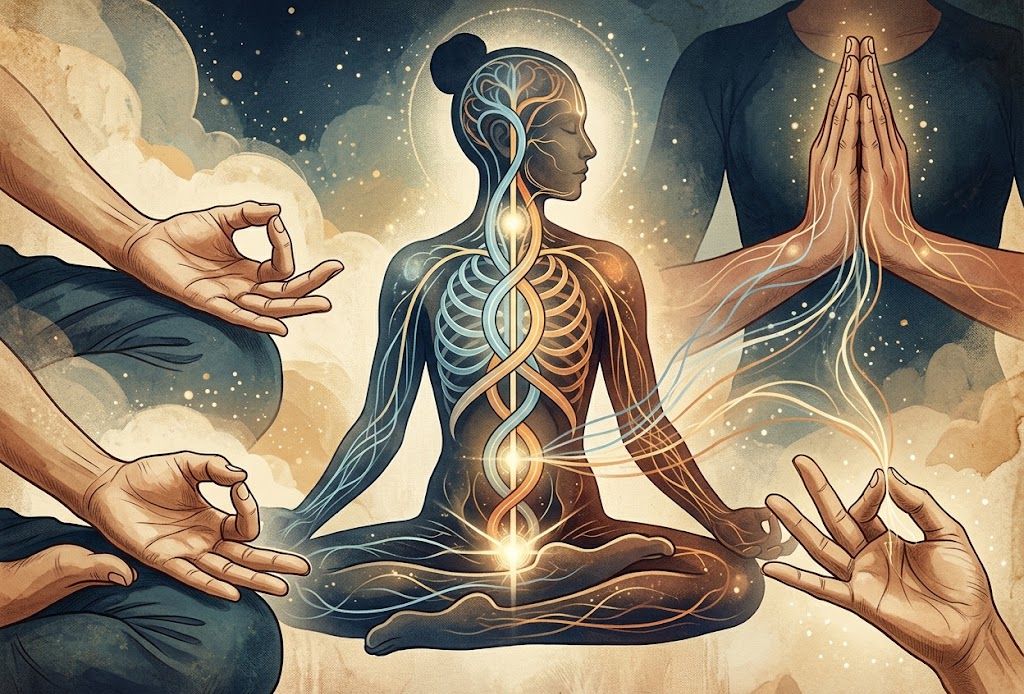
The nadis are the channels of the subtle body. The word means channel, current or tube, and classical texts list 72,000 of them, of which three govern the others: ida, pingala and sushumna. Ida runs along the left side and ends at the left nostril; pingala runs along the right; and sushumna rises through the center, along the spine. Tradition associates ida with the lunar and cool principle, and pingala with the solar and warm principle. One classical explanation of the name hatha understands it as the union of the sun (ha) and the moon (tha).
The text links sushumna to the purpose of the entire practice. According to the Hatha Yoga Pradipika, when the nadis are impure, the breath does not enter sushumna, and without this, the state of deep concentration that the text calls unmani cannot be attained. For this reason, the second chapter prescribes the purification of the channels: alternate-nostril breathing, nadi shodhana, in which inhalation takes place through one nostril and exhalation through the other, with retention in between. Together with the cleansing techniques discussed in the article on kriya, this practice prepares the ground.
Other traditions describe similar channels. In Tibetan Buddhism, three main channels appear under different names: roma, kyangma and uma, corresponding to pingala, ida and sushumna. As with the chakras, the scheme varies according to the school, while the underlying idea remains that of a central axis flanked by two currents.
Mudra means seal. The word is translated as seal, mark or gesture, and in India it refers to symbolic postures and gestures used in ritual, iconography, dance and yoga. In hatha yoga, mudras are primarily internal actions involving the pelvic floor, diaphragm, throat, eyes, tongue and abdomen. They are practiced alongside pranayama to direct prana. Their number increased over the centuries: three in the Amritasiddhi, ten in the Hatha Yoga Pradipika and twenty-five in the Gheranda Samhita.
The Hatha Yoga Pradipika brings together ten mudras in its third chapter. They are maha mudra, maha bandha, maha vedha, khechari, uddiyana bandha, mula bandha, jalandhara bandha, viparita karani, vajroli and shakti chalana. The text states that they destroy old age and death, and presents them as a set transmitted by Shiva, with a specific purpose: to awaken kundalini and guide prana through sushumna. The three bandhas are included among them, meaning that bandhas are a category of mudra, and in hatha yoga literature the distinction between the two is flexible.
The three main bandhas act on the pelvis, abdomen and throat. Bandha means bond or tie, and is translated as lock. Mula bandha acts at the base: the text instructs practitioners to press the perineum with the heel and contract, so that apana, whose current flows downward, is directed upward. Uddiyana bandha acts on the abdomen: it is described as a drawing inward and upward, traditionally after exhalation. Its name means flying upward, because through it prana rises like a bird through sushumna. Jalandhara bandha acts on the throat and consists of contracting it while firmly resting the chin against the chest. These three areas correspond to those associated with apana, samana and udana, the currents we discussed in the article on the vayus.
They are applied together with breath retention. In hatha yoga, bandhas are part of pranayama with kumbhaka, the pause after inhalation or exhalation, and the texts recommend mastering each one separately before combining them. Together, the three form maha bandha, and the text describes the result as the union of prana and apana, which awakens kundalini and directs the breath into sushumna. It is the same sequence we explored in the article on kundalini, now viewed from the technical side.
In modern practice, their uses are broader and gentler. In styles derived from vinyasa krama, mula and uddiyana are maintained lightly during postures and transitions, while hand gestures such as jnana mudra are used in meditation. These uses developed after those described in the classical texts, and although they share the same names, their contexts are different. As with other techniques involving the breath, the more demanding practices are learned under the guidance of someone familiar with the tradition.
Ayurveda describes a body with its own channels. Alongside the vocabulary of yoga is Ayurveda, India's traditional system of medicine, which refers to srotas, the channels of the body, including those that carry the breath. Its concept of Vata is divided into five currents bearing the same names as the vayus: prana, udana, samana, vyana and apana. Yoga and medicine thus share part of their vocabulary, but with different emphases: one oriented toward contemplative practice, the other toward caring for the body. This common ground is the starting point for the next article.