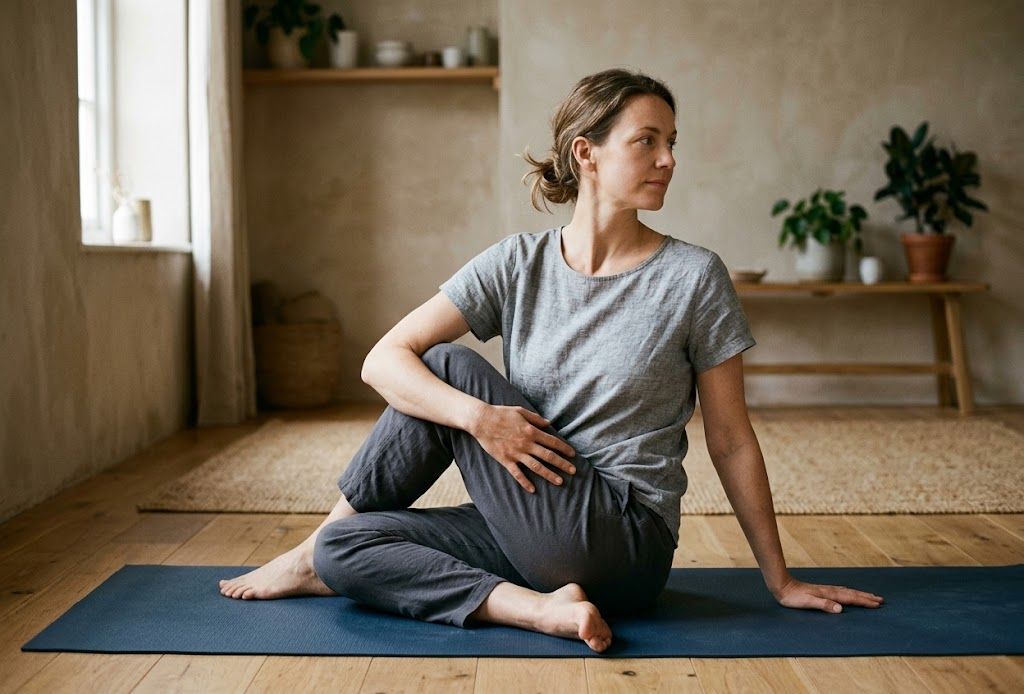
In yoga practice, the spine is worked through four fundamental movements: forward flexion, backward extension, lateral flexion (side bending), and torsion (rotation). Each of these movements has its own biomechanical logic and is linked in a specific way to the breath. Understanding them allows for a more conscious and safer practice, without needing to force or seek extreme shapes.
Forward flexion is the movement that brings the chest toward the legs, curving the spine forward. Biomechanically, this gesture begins in the pelvis: if the pelvis tilts correctly, the spine lowers without compressing the lower back. It is not about touching the floor or rounding the back abruptly, but about decompressing the posterior part of the vertebrae. Breathing accompanies this movement mainly during exhalation, because as the abdomen empties, the diaphragm rises and allows the torso to fold more easily. Poses like standing forward fold or seated forward fold work this movement, and what matters is not the depth but the sensation of lengthening in the lower back and behind the legs.
Extension or backward flexion is the opposite movement: opening the chest and arching the spine backward. The most common risk here is concentrating the entire arch in the lower back, which generates compression and eventually pain. A healthy extension is distributed throughout the entire spine: cervical, thoracic, and lumbar, and to achieve this it is necessary to lengthen before arching, creating space between each vertebra. Breathing in this movement is dominated by inhalation, because as you inhale the diaphragm descends, the ribs expand, and the chest opens naturally. Poses like cobra or upward-facing dog are classic examples, and the key is to seek a gentle and sustained arch, not to force the curvature to the extreme.
Lateral flexion consists of bending the torso to one side, as if trying to bring the ear toward the shoulder on the same side. Biomechanically, this movement is often misunderstood: it is not about shrinking one side of the body, but about lengthening the opposite side from the bend. The pelvis must remain stable so that the stretch is real and not simply a displacement of the torso. Breathing here has a dual role: you inhale to lengthen the spine from the hip to the armpit, and you exhale to gently deepen the bend. The side being stretched, which is the upper side, also receives a more noticeable respiratory expansion. Poses like standing half moon work this movement, and just a few centimeters of a well-executed bend are enough to gain benefit.
Torsion or rotation is the fourth movement: turning the spine on its own axis, so that the vertebrae rotate relative to one another. The most frequent mistake is to twist only from the shoulders or from the head, without involving the base of the spine. An effective twist begins from the pelvis or from the lower back, depending on the pose, and before twisting it is essential to lengthen the spine as if someone were pulling the crown of the head upward. That prior lengthening creates space between the vertebrae and prevents compression of the intervertebral discs. Breathing in twists follows a clear pattern: you inhale to lengthen and create space, and you exhale to gently rotate. Each exhalation allows a small advance in the twist, but there should never be pain. Poses like seated twist or standing twist are common examples, and the correct measure is not how much you twist, but whether the breath remains fluid.
Breathing is not an accessory in these four movements, but the mechanism that makes them safe and effective. In forward flexion, exhalation guides the fold; in extension, inhalation opens the chest; in lateral flexion, inhalation lengthens and exhalation deepens; and in torsion, inhalation creates space while exhalation executes the twist. This link between breath and movement protects the spine because it prevents sudden movements and forces you to maintain awareness in each phase of the pose. Without conscious breathing, spinal movements lose their therapeutic quality and become mere contortions.
From an anatomical perspective, these four movements maintain the health of the intervertebral discs and the deep back muscles. Intervertebral discs have no direct blood supply; they are nourished by a pumping mechanism that occurs when the spine moves and alternately compresses and decompresses. Forward flexion, extension, lateral bending, and torsion generate exactly that pumping, bringing fluid and nutrients to the discs and removing waste. At the same time, the paraspinal muscles and the core are strengthened in a balanced way when all four movements are explored, avoiding the imbalances that appear when a person only moves in one or two directions in their daily life.
For daily practice, there is no need to perform advanced poses or force the ranges of motion. A forward fold with bent knees, a gentle extension lifting the chest just a few centimeters off the floor, a lateral bend of just a few centimeters, and a twist where the rotation is minimal but conscious are more beneficial than extreme versions done without breath. The spine appreciates variety of movement, not maximum intensity in just one. Alternating the four types of movement in the same session, even in a very simple way, keeps the back mobile, the discs hydrated, and the nervous system calm.