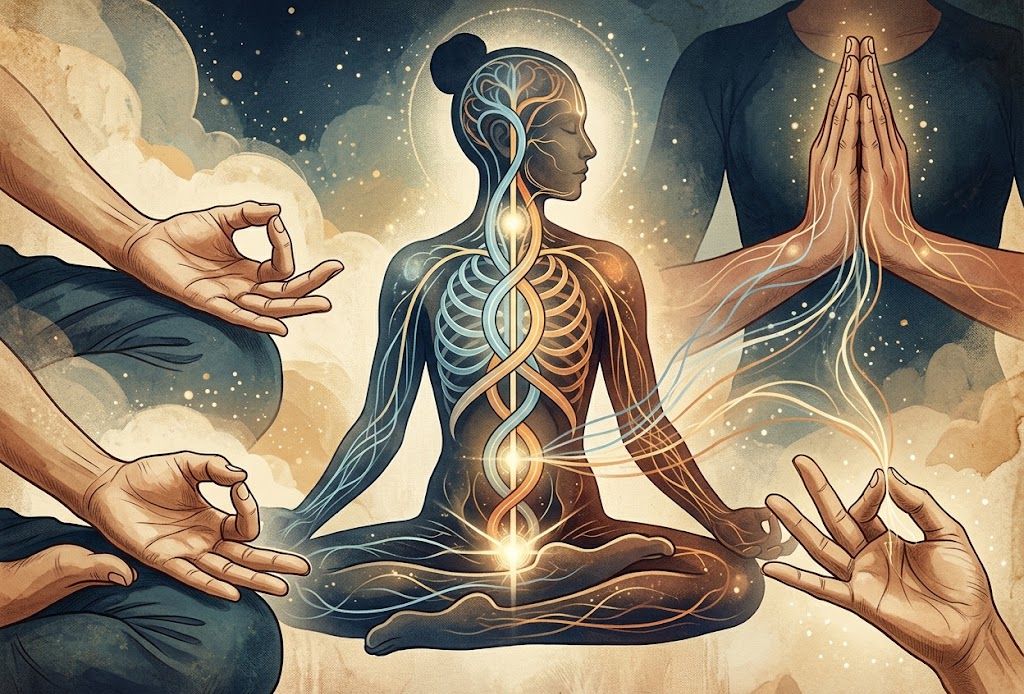
Prana is not a uniform energy that circulates in the same way throughout the entire body. The yoga tradition describes it as organized into five distinct currents, each with its own direction, its zone of action, and its function: they are the vayus, literally "winds." Understanding this distinction is not a theoretical exercise — it is what allows us to know why the same practice affects breathing, digestion, voice, or circulation in such different ways.
Prana vayu governs movement inward and upward. It acts mainly in the chest and head, and is responsible for inhalation, for the reception of stimuli, and for the capacity to absorb what arrives from the environment — air, food, impressions, ideas. When prana vayu functions clearly, there is genuine enthusiasm, curiosity, and an awakened sensitivity toward what is happening around us. When it is disturbed, dispersion appears: everything is received halfway, without the capacity to assimilate anything in depth.
Apana vayu is the opposite movement: outward and downward. It is located in the pelvis and lower abdomen, and governs everything the body needs to release — exhalation, elimination, childbirth, the discharge of what has already fulfilled its function. It is not only a physiological process; it is also the psychological capacity to let go. A weak apana vayu manifests as difficulty in letting go, both in the body and in thoughts that repeat unnecessarily.
Samana vayu does not push in any direction: it balances. It acts in the area of the navel, the digestive center of the organism, and its function is to consolidate what prana vayu received before apana vayu eliminates it. It is the vayu of assimilation — it turns food into nutrients, information into understanding, experience into learning. When samana vayu is strong, things integrate; when it is weak, they accumulate without being digested, whether as physical discomfort or as mental confusion.
Udana vayu moves upward and outward, from the throat toward the head. It governs speech, growth, upright posture, and the will to express oneself. It is the vayu that allows us to stand up, sustain our own judgment, and communicate what we think with clarity. A weakened udana vayu is noticed in a dull voice, in a slumped posture, in the difficulty of holding a position before others — not for lack of inner conviction, but because that conviction fails to manifest outwardly.
Vyana vayu is the only one that does not have a fixed direction: it expands from the center toward the entire periphery of the body. It is the vayu of circulation and coordination — it distributes what the other four generate and keeps the whole unified. It pulses in the heartbeat, in blood circulation, in the capacity to coordinate complex movements. When vyana vayu works well, the body acts as a single unit; when it is weakened, clumsiness appears, a disconnection between what one decides to do and what the body actually executes.
The five vayus do not operate in isolation: they are a single energy fulfilling different functions according to the moment and the place. A well-constructed asana practice — with the logic of vinyasa krama that we described in the previous article — orders them in sequence: first reception is activated (prana), then it is consolidated (samana), then what is left over is released (apana), and throughout the whole process udana sustains the posture and vyana distributes the effect throughout the entire body. There is no one vayu more important than another. There is a correct moment for each one, and recognizing that moment is a large part of what distinguishes a conscious practice from a simple repetition of movements.