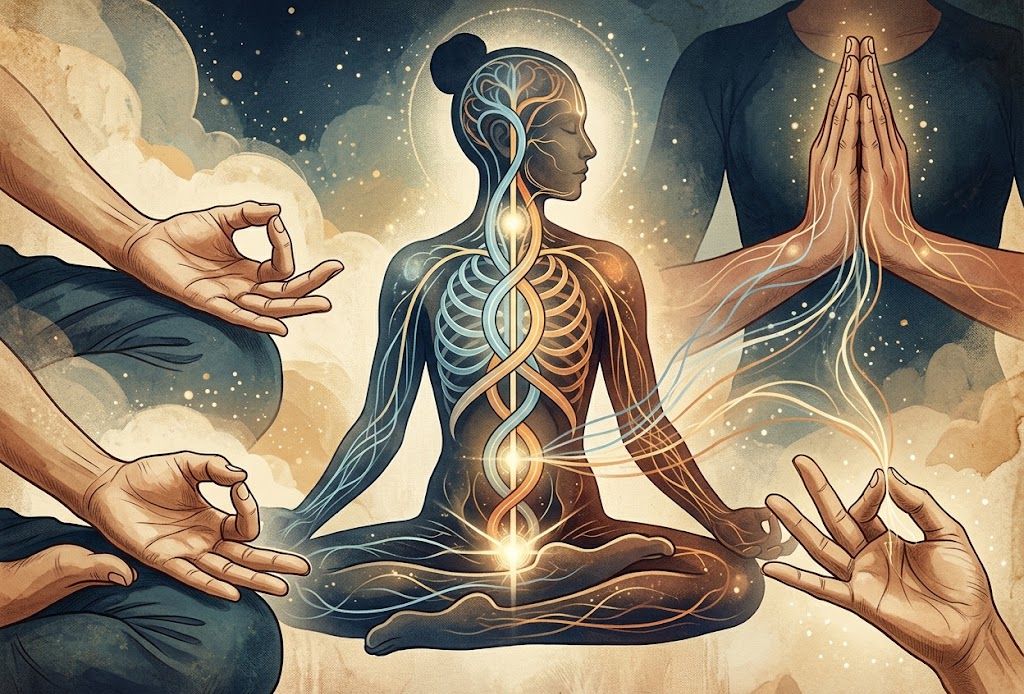
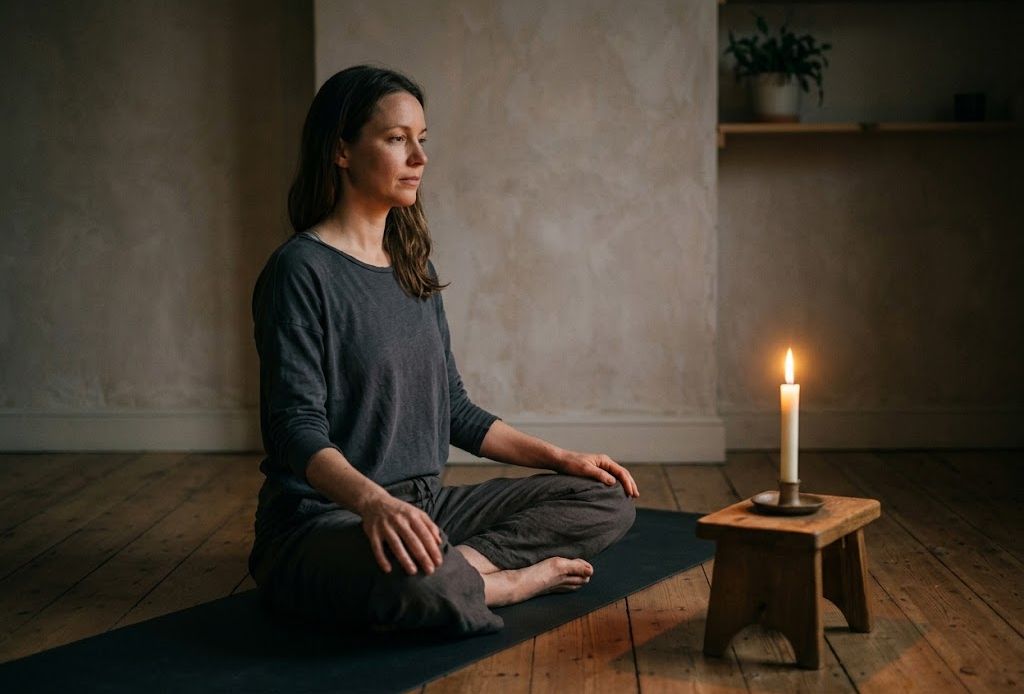
The Yoga Sutra of Patanjali describes eight dimensions of yoga, which he calls ashtanga: eight limbs that do not develop in sequence but simultaneously. The first five — yama, niyama, asana, pranayama, and pratyahara — prepare the conditions of the organism and the mind. The last three — dharana, dhyana, and samadhi — describe progressive states of concentration. When these three states converge on the same object, the result is called Samyama.
Pratyahara is the prior state, the condition that makes everything that follows possible. The word ahara means food; pratyahara describes the moment when the senses stop feeding on external stimuli. It is neither suppression nor sensory anesthesia. It is the state in which the mind is so absorbed in an object that the senses simply follow it, without dispersing toward other stimuli. It occurs spontaneously in states of deep concentration: a musician completely absorbed in what they are playing, a researcher immersed in a problem, someone in pranayama whose attention is entirely directed to the breath. In those moments the senses do not die; they reorient. They cease to be masters and become instruments.
Dharana is the first active state of concentration. The root dhr means to hold. The classical image is that of a water dam with several channels: if all are the same depth, the water distributes equally in all directions. If one is deeper than the others, the water flows mainly through it. Dharana is that deeper channel: the mind directed toward a single object, progressively closing itself off to distractions. The object can be anything — the breath, an area of the body, a sound, an image, a concept. What defines dharana is not the object but the exclusive direction of attention toward it. In this state distraction is still possible; the mind is oriented but not yet completely fused with what it observes.
Dhyana is the connection established when dharana deepens. If dharana is contact, dhyana is communication. The mind no longer merely points toward the object; it interacts with it in a continuous and sustained way. In this state there still exists an awareness of the observer: there is an "I" that registers the process. Distraction becomes much less likely because the connection between the mind and the object is denser. Dhyana is not practiced in the conventional sense of the word; it is not something executed but something that occurs when conditions are right. To say "I am meditating" is technically imprecise: what one does is create the conditions for dhyana to arise.
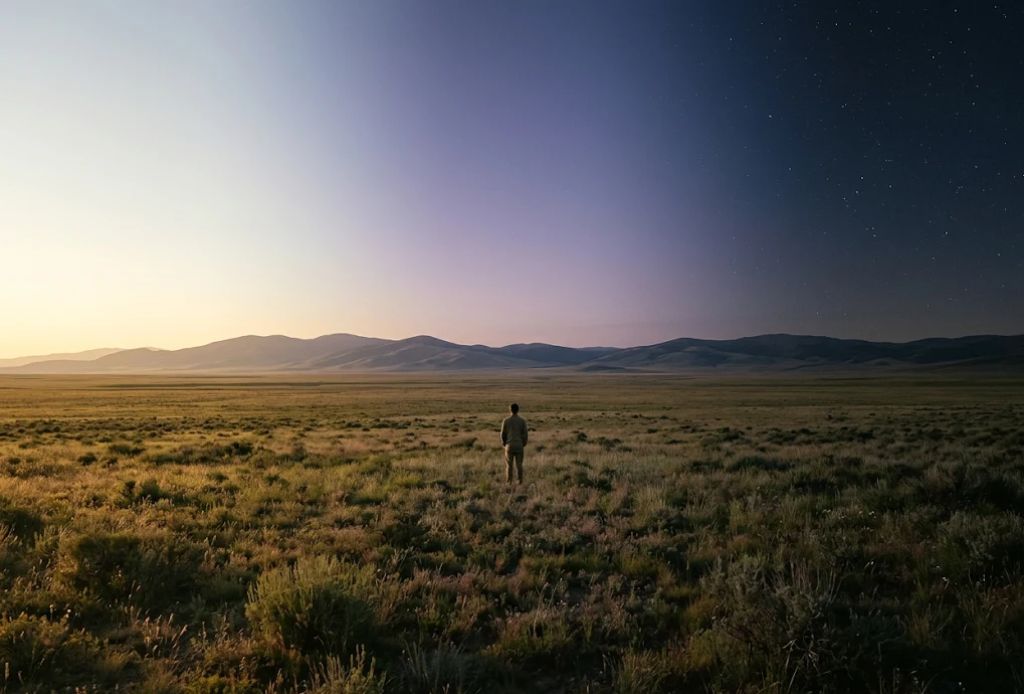
Samadhi is the state in which the space between the observer and the observed becomes imperceptible. The word means to bring together, to merge. In samadhi the habitual identity — name, history, personal references — withdraws completely from the foreground. Not because it disappears, but because the absorption in the object is so total that there is no place for it. What predominates is prajna, a direct and unimpeded understanding of the object as it is. It is not a state of ignorance or sleep; it is the opposite: a clarity in which one perceives what normally remains hidden behind layers of interpretation and mental habit.
Samyama is the condition in which dharana, dhyana, and samadhi are simultaneously directed toward the same object. Sam means together; yama can be translated as discipline or restraint. It is not a technique to be applied but a state that is sustained: attention completely focused on an object for long enough that all three levels of concentration operate together. The effect of Samyama is a progressive and ever-deepening knowledge of the chosen object. Patanjali mentions that Samyama can release extraordinary capacities, but clarifies that these capacities are a side effect, not the purpose. The purpose is knowledge itself: understanding an object with a depth that ordinary thought cannot reach. If the capacities become the goal, the meaning of the practice is lost.
The cumulative effect of sustained samadhi on the personality is what the Yoga Sutra calls kaivalya. The word derives from kevala, meaning to keep for oneself. Kaivalya does not describe a state of withdrawal from the world or indifference toward it. It describes a quality of presence: the person in kaivalya lives in the world and functions in it normally, but is not bound by it. External forces have no power to destabilize them because their center does not depend on circumstances. They have not been freed from the body or from sensory perception; they simply no longer confuse these with their identity. They see the material world as it is, without adding meanings it does not have.
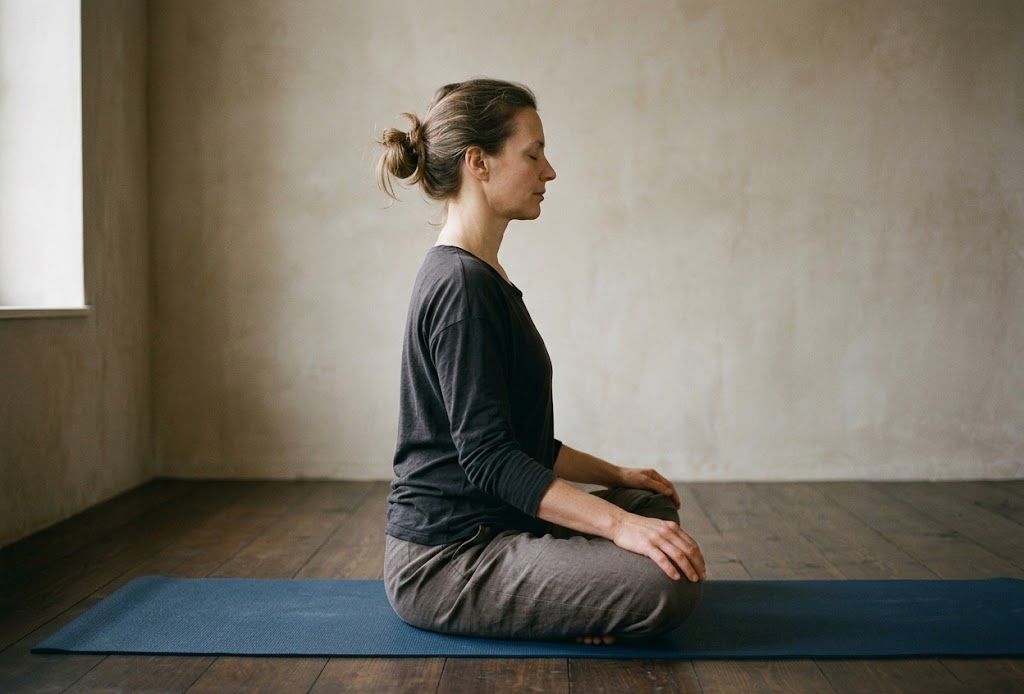
None of these states is produced by direct decision. It is not possible to sit down and decree "now I will do dharana." What is possible is to build the conditions that favor them: asana and pranayama stabilize the nervous system and create space in mental activity; pratyahara occurs as a natural consequence of that stabilization. When the mind is sufficiently still, dharana can appear. When dharana is sustained, dhyana can follow. When dhyana deepens enough, samadhi occurs. And when samadhi becomes the predominant state of the mind, kaivalya is its expression in daily life. Each state is the condition of the next; none is forced.
Are dharana and dhyana the same? No. Dharana is orientation: the mind chooses an object and begins to move toward it. Distraction still competes. Dhyana is what happens when that orientation becomes so continuous that distraction loses its weight. The transition from one to the other does not depend on greater effort but on an accumulation of conditions. One does not decide to enter dhyana; one notices that it has occurred.
Can samadhi be practiced? The question contains a trap. Samadhi is not a technique but a state. What is practiced are the conditions that make it possible: the stability of the body, the regulation of breath, the sustained direction of attention. The state itself appears or does not appear. Attempting to produce it by direct will is contradictory: the tension of the attempt is precisely what prevents it.
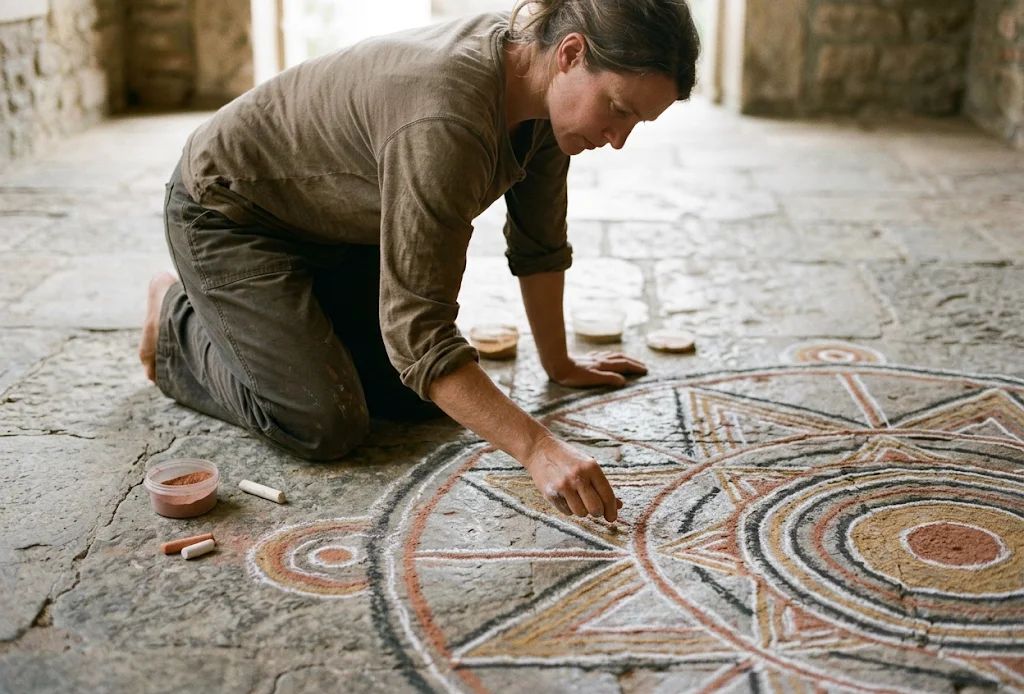
Are these states exclusive to formal practice? No. Any process of genuine understanding contains them to some degree. A scientist who, after weeks of work, suddenly sees the structure of a problem; a composer who finds the harmonic resolution they were seeking; a craftsperson completely absorbed in their craft: in all these cases the same mechanisms that the Yoga Sutra describes are at work. The difference with formal practice is that there the conditions are built intentionally and in a sustained way, not accidentally.
On what object is Samyama practiced? On any object that does not generate resistance. The Yoga Sutra does not prescribe a universal object because each person's starting point is different. What matters is not what is chosen but that the choice does not block concentration. An object that generates internal conflict — for cultural, philosophical, or personal reasons — fragments attention before it can be sustained. The depth of knowledge that Samyama produces does not depend on the object but on the quality of the attention directed toward it.
Is kaivalya a permanent state? The Yoga Sutra describes it as the result of samadhi sustained over time, not as a one-time achievement. The mind alternates between clarity and confusion until clarity becomes the predominant state. It is not a destination with a fixed date; it is a direction that consolidates gradually. What characterizes kaivalya is not the absence of difficult experiences but the absence of identification with them.