Yoga

Krama


An asana session is not a collection of postures. It is a sequence with an internal logic: a starting point, a direction, and a return. That return does not lead back to the same place where it began. Practice transforms the practitioner. The Yoga Sūtra describes this logic through the concept of vinyasa krama: a gradual and intelligently organized progression in which each step leads to the next in the right direction. Vamana, an ancient yogi, stated that it is not possible to master asanas without vinyasa. It is not enough to execute a step; that step must take us in the right direction and be performed in the right way.

The starting point is always the organism's present condition. Not the desired condition, nor the condition of the previous day. The state of the joints upon waking, the quality of the breath at that moment, accumulated tensions, and the available energy. Observing this state before beginning is not an optional preliminary; it is the foundation of the entire sequence. The situation from which one begins changes constantly, and practice must adapt to it every time.

The ideal asana possesses two simultaneous qualities: sthira and sukha, alert steadiness and comfortable ease. The image used by the Yoga Sūtra is that of the god Viṣṇu resting upon Ananta, the king of serpents: the serpent's body is soft enough to support a god and firm enough to support the world. These two qualities coexist without canceling each other out. In practice, this means that effort is regulated and progressively reduced as the posture is refined. A forced posture is not sthira; a posture without attention is not sukha.

The session is built in stages. It begins with simple postures that warm and loosen the body globally: forward bends, arm raises, and movements that prepare the joints without demanding too much from them yet. It is not advisable to begin with backbends, deep twists, or inverted postures. The body needs time to register its own condition before being taken into more demanding positions. Dynamic practice—entering and leaving the posture in rhythm with the breath—always precedes static practice, in which the posture is maintained for several breathing cycles.

Each asana produces two effects: one positive and one negative. Intelligent practice does not ignore the second; it neutralizes it. The postures designed for this purpose are called pratikriyasanas, counter-postures. Headstand reverses the effects of gravity but places the entire weight of the body on the neck, a structure designed only to support the head. Without an appropriate counter-posture, this tension accumulates silently until it produces chronic stiffness or vertebral damage. The principle applies to the entire sequence: an intense backbend is followed by a gentle forward bend; a deep forward bend is followed by a gentle backbend. It is not enough to climb the tree; one must also know how to come down.

Breath organizes movement; it does not merely accompany it. Every stage of a posture has a natural breathing pattern. Forward bends favor slow exhalation and its retention, what the Yoga Sūtra calls laṅghana: a process of reduction and purification that stimulates the abdominal organs. Backbends favor deep inhalation and its retention, bṛṃhaṇa: an expansive process that warms and energizes the system. As long as the breath remains smooth and continuous, practice stays within the body's limits. When breathing becomes interrupted or forced, it is a sign that those limits have been crossed.

Rest between postures is not passive. It is the time during which the muscles recover their tone, the nervous system registers the effects of what has just occurred, and the body returns to a state of balance before the next demand. Omitting this rest does not accelerate practice; it strips it of information. A good asana session ends where it can end: with the body ready to resume the activities of the day without carrying any new tension.

November 2026

AUM

Cultura Yoga

AUM
November 19, 2026

Enter
Turiya

Cultura Yoga

Turiya
November 17, 2026

Enter
Tantra

Cultura Yoga

Tantra
November 12, 2026

Enter
Bandhas Nadis Mudras

Cultura Yoga

Bandhas Nadis Mudras
November 10, 2026

Enter
Kundalini

Cultura Yoga

Kundalini
November 5, 2026

Enter
Kriya

Cultura Yoga

Kriya
November 3, 2026

Enter
Gita

Cultura Yoga

Gita
November 1, 2026

Enter
Ayurveda

Cultura Yoga

Ayurveda
November 1, 2026

Enter

Yoga Classes

Yoga classes offer a space where mind and body integrate, cultivating balance and well-being. It is not just about physical postures, but also about breathing with awareness and finding serenity through practice.

Each session invites you to dedicate a moment to yourself, combining movement, breathing, and calm. Over time, yoga strengthens the body, quiets the mind, and helps generate holistic well-being.

Meditation tip

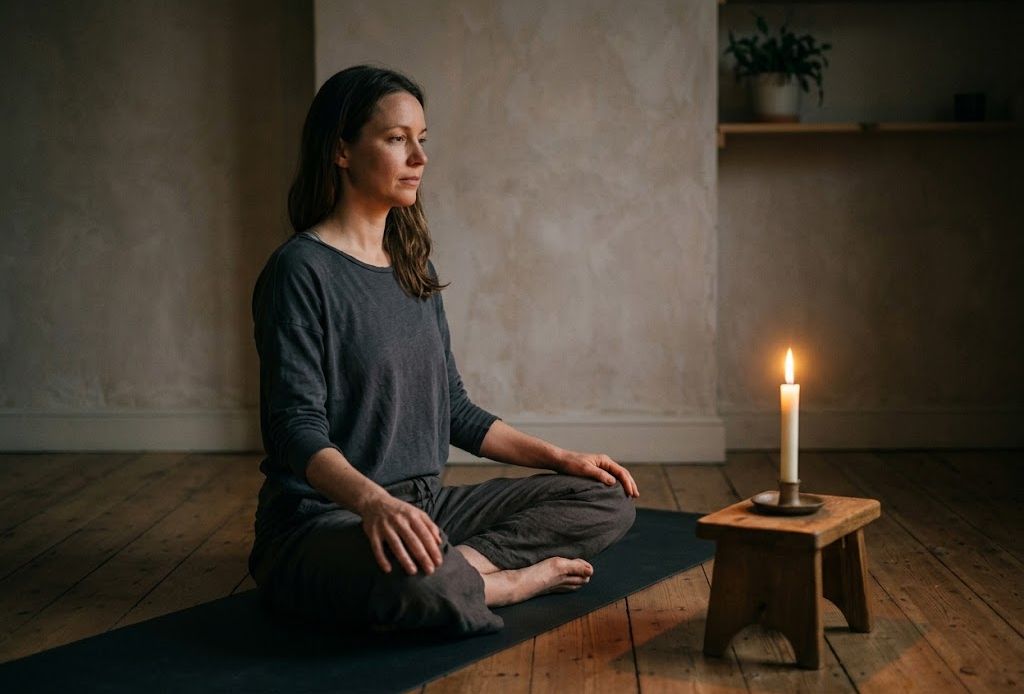
Find a quiet place and get comfortable, seated or lying down, whichever works best for you. Try starting with just three minutes: close your eyes and follow the rhythm of your breath. When your mind wanders, which it will, gently return to your breath without judging yourself. That returning, again and again, is the practice.

Contact

Activities 2027

Astrology: Workshops 2027

- 100% Online Workshops.
- Each workshop is independent.
- Virtual Classroom with all the content.

Join one or all of them. Throughout the year we move from the fundamentals to practical application, to better understand your own inner processes.

Yoga and Meditation: Workshops 2027

- 100% Online Workshops.
- Each workshop is independent.
- Virtual Classroom with all the content.

Join one or all of them. Spaces to practice, learn and find balance, with topics to be confirmed.