Ayurveda describes three basic constitutions — Vata, Pitta and Kapha — which are not fixed categories but tendencies of the organism. The practice of yoga is no stranger to this description. What balances one constitution may aggravate another, and what stimulates one may be exactly what another needs to avoid.
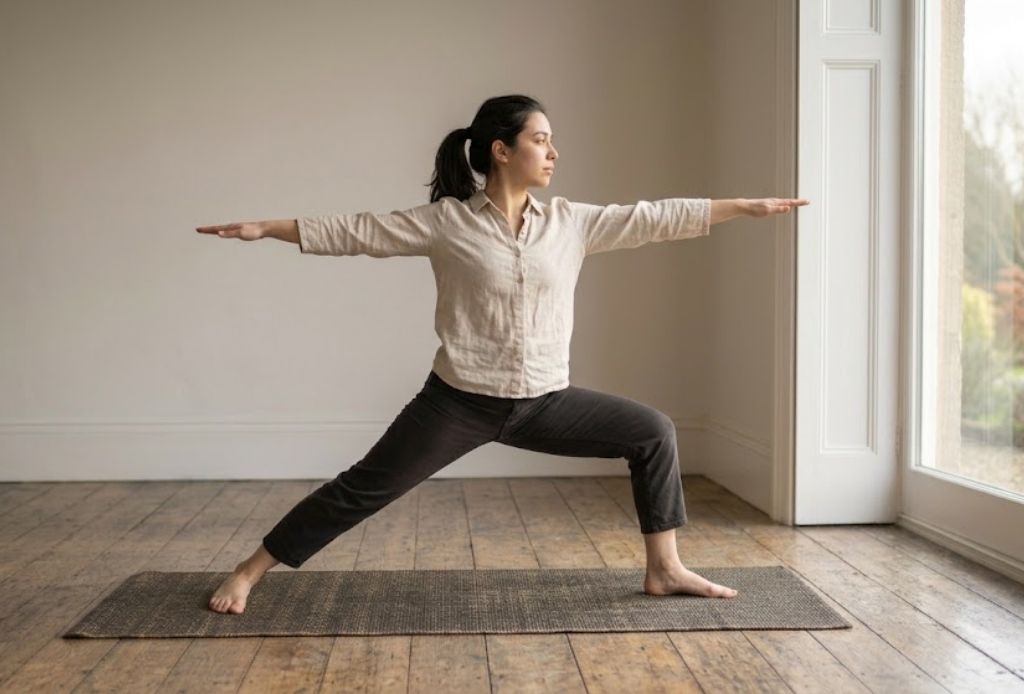
Vata is composed of ether and air: it is light, mobile, cold and dry. In imbalance, it produces dispersion, anxiety, digestive irregularity and insomnia. A yoga practice for excess Vata does not need more movement but more earth. Grounding postures: Tadasana, Virabhadrasana I, seated and floor postures. Slow, sustained movements, with special attention to a long exhalation. Ujjayi breathing helps to warm and stabilise. What Vata needs to avoid is overly dynamic practice, rapid changes of posture and effort without rest.
Pitta is composed of fire and water: it is hot, intense, sharp and precise. In imbalance, it produces irritability, inflammation, excessive competitiveness and rigid perfectionism. A yoga practice for excess Pitta needs cooling and letting go. Forward bends, restorative postures, gentle twists. The emphasis is on surrender rather than achievement — Pitta tends to turn practice into a competition with itself. Slow breathing and extended exhalation help lower internal temperature. What Pitta needs to avoid is very hot practice, fast pacing and comparison with previous sessions.
Kapha is composed of earth and water: it is heavy, stable, cold and dense. In imbalance, it produces metabolic sluggishness, resistance to change, congestion and a tendency toward attachment. A yoga practice for excess Kapha needs activation and heat. Sun salutations, standing postures, dynamic movements that generate circulation. The emphasis is on maintaining rhythm without staying too long in each posture. Kapalabhati breathing helps to cleanse and activate. What Kapha needs to avoid is overly slow practice, prolonged restorative postures, and short, irregular sessions.
Most people do not respond to a single dosha but to a combination of two. In that case the criterion is the same as that established by Viniyoga: start from where you are. If you are Vata-Pitta, observe which of the two is more aggravated at this moment and orient the practice toward that balance. If you are Pitta-Kapha, recognise that in summer Pitta naturally aggravates and in winter Kapha does, and adjust according to the season. There is no fixed formula because the organism changes and the practice must change with it.
The predominant dosha is the starting point but not the only criterion. The state of the day matters as much as the base constitution. A Kapha who arrives at practice after a week of much movement and stress may need a more restorative session than an activating one. A Vata who is in a period of stability and routine may tolerate a more dynamic practice than usual. Observation of the present state — which is exactly what we describe in The Terrain — always takes priority over the constitutional category.
The doshas are not a diagnosis but a compass. They point in a direction without imposing a fixed route. Intelligent practice uses them as information, not as rule. And that information is always verified in real time through the most reliable criterion that exists: the quality of the breath within the posture.